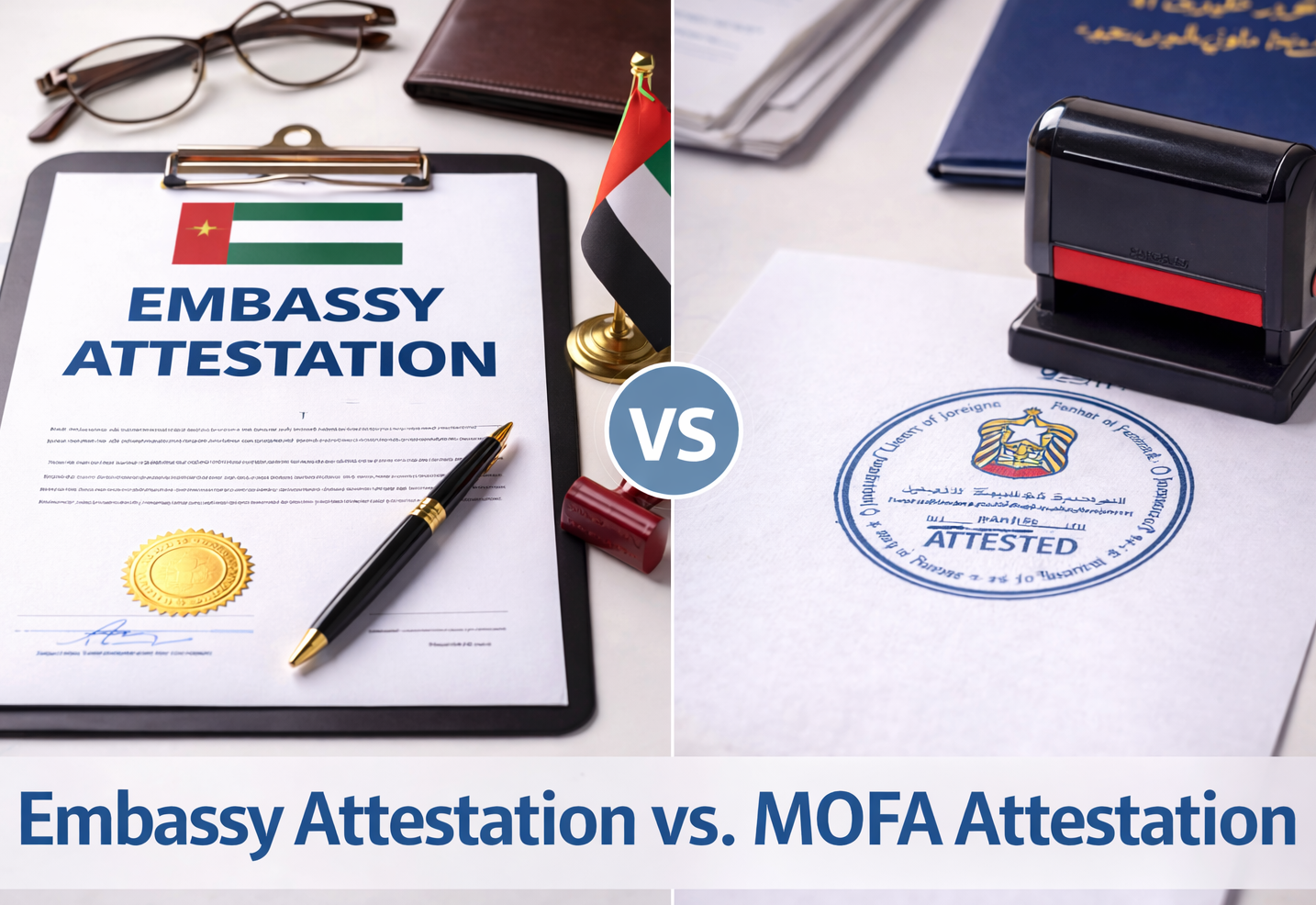
The difference between embassy attestation and MOFA attestation is important to understand when preparing documents for official use in the United Arab Emirates (UAE). Whether you are applying for employment, sponsoring family members, pursuing higher education, or establishing a business, your documents must undergo a legal verification process to be accepted by UAE authorities.
Many people confuse embassy attestation with MOFA attestation because both involve document authentication. However, these processes are performed by different authorities and serve different purposes. Understanding the difference between embassy attestation and MOFA attestation can help you complete the document legalization process smoothly and avoid unnecessary delays.
What Is Embassy Attestation?
Embassy attestation is the process through which the UAE Embassy or Consulate in the document’s country of origin verifies the authenticity of the document. This confirms that the document has already been authenticated by local authorities and government departments in the issuing country.
Embassy attestation is generally completed after approval from the Ministry of Foreign Affairs or other authorized departments in the home country.
Once the UAE Embassy attests the document, it becomes eligible for final verification within the UAE.
Embassy attestation is commonly required for:
- Educational certificates
- Birth certificates
- Marriage certificates
- Commercial documents
- Legal documents
For detailed requirements, read our guide on Documents Required for UAE Embassy Attestation.
What Is MOFA Attestation?
MOFA attestation refers to the verification process carried out by the UAE Ministry of Foreign Affairs (MOFA). It is the final stage in the document attestation process for documents intended for use within the UAE.
After UAE Embassy attestation is completed in the issuing country, the document must be submitted to MOFA in the UAE for final legalization. Once MOFA attestation is complete, the document becomes legally valid and accepted by UAE government departments and institutions.
MOFA attestation is commonly required for:
- Employment visa applications
- Family visa sponsorship
- University admissions in the UAE
- Business and commercial activities
- Legal and government procedures
Learn more through our Step-by-Step MOFA Attestation Process in UAE guide.
Difference Between Embassy Attestation and MOFA Attestation
| Feature | Embassy Attestation | MOFA Attestation |
|---|---|---|
| Authority | UAE Embassy or Consulate in the issuing country | Ministry of Foreign Affairs (MOFA) in the UAE |
| Purpose | Verifies documents in the home country | Provides final legalization within the UAE |
| Process Stage | Completed before the document enters the UAE | Final step after arrival in the UAE |
| Document Status | Approved for UAE use | Fully legalized and accepted in the UAE |
| Location | Outside the UAE | Within the UAE |
This comparison highlights the difference between embassy attestation and MOFA attestation and explains why both steps are necessary for legal document use in the UAE.
UAE Document Attestation Process: Step by Step
Step 1: Notary Attestation
The process begins with verification by a local notary public or issuing authority.
Our Notary Public Services Dubai can assist with notarization requirements.
Step 2: Government Department Attestation
Relevant government departments authenticate the document based on its type.
Examples include:
- Ministry of Education for academic certificates
- Home Department for personal documents
- Chamber of Commerce for commercial documents
Step 3: Ministry of Foreign Affairs (Home Country)
The Ministry of Foreign Affairs in the issuing country authenticates the document for international use.
Step 4: UAE Embassy Attestation
The UAE Embassy or Consulate verifies the document and approves it for use in the UAE.
Step 5: MOFA Attestation in the UAE
The final stage involves MOFA attestation, making the document legally valid throughout the UAE.
Professional Documents Attestation Services Dubai can simplify this entire process.
Why Are Both Attestations Important?
Both embassy attestation and MOFA attestation play essential roles in the document legalization process.
- Embassy attestation confirms the document’s authenticity in the issuing country.
- MOFA attestation confirms the document’s legal validity within the UAE.
Skipping either step may result in document rejection by UAE employers, educational institutions, or government authorities.
Understanding the difference between embassy attestation and MOFA attestation helps ensure compliance with UAE legal requirements.
Common Documents Requiring Both Attestations
The following documents often require both embassy and MOFA attestation:
- Educational certificates for employment
- Birth certificates for family visa applications
- Marriage certificates for spouse sponsorship
- Commercial documents for business setup
- Power of Attorney and legal documents
If your documents require translation, our Legal Translation Services Dubai can provide certified translations accepted by UAE authorities.
Benefits of Professional Attestation Services
Many individuals and businesses choose professional attestation providers to streamline the process.
Benefits include:
- Faster document processing
- Expert guidance on requirements
- Reduced risk of delays or rejection
- Efficient management of embassy and MOFA procedures
- Time savings and convenience
Conclusion
Understanding the difference between embassy attestation and MOFA attestation is crucial for anyone planning to use foreign documents in the UAE. Embassy attestation verifies documents in the issuing country, while MOFA attestation provides final legalization within the UAE.
Following the complete attestation process ensures that your documents are legally recognized by UAE government departments, employers, and institutions. Proper attestation saves time, prevents complications, and helps you achieve your personal, educational, or business goals in the UAE.
Add a Comment